

The late afternoon of the November 6th (2025) arrived with a welcome coolness. A breeze moved through the branches of a tree that had fallen for the passion fruit vine growing just outside the entrance of the Auditorium of the Portuguese Cultural Centre in Praia. Together, swaying to the rhythm of the wind, they seemed to whistle softly — almost as if announcing what the Auditorium had in store for us.
Inside, there was a Stage that afternoon in quiet conversation with the Trees. On it, the production team, the teacher, and the sound and lighting technicians were also in conversation with the plants and shrubs that dressed the stage — passing along the messages sent by the passion fruit vine.
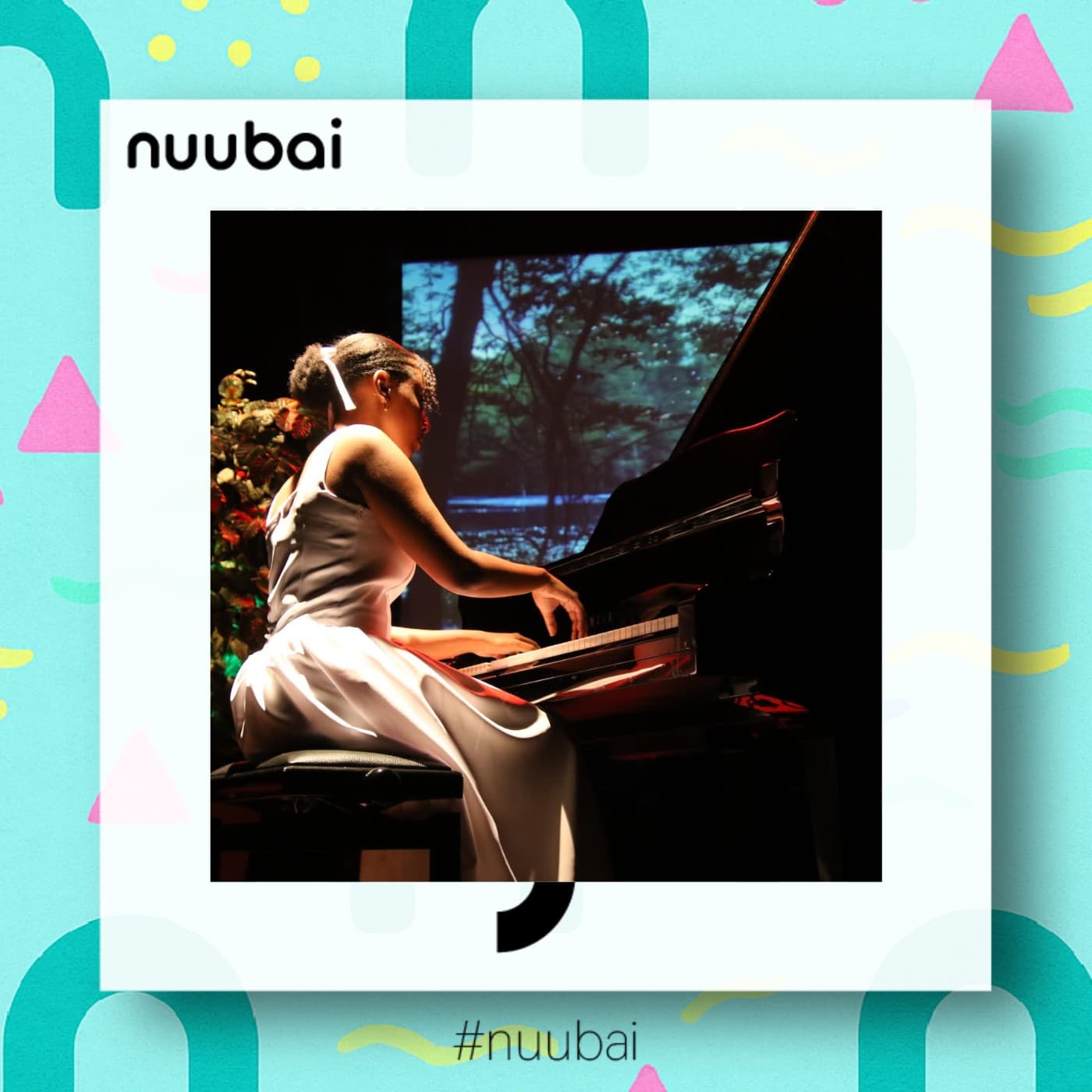
The stage received them. And answered. It gave us its brightest star — Alicia Freitas, Piano. In the opening, the young pianist from Pentagrama Music School welcomed the audience, receiving them in a sound that still carried the sway of the passion fruit vine and the first notes of the evening. She made the room. With the audience settled, two tiny pianists — pikinotis — charmed us completely, bowing with the rigour the occasion demanded.
The String Trio and the Magic of "Childhood Notes, Chords and Tomorrow's Stages." A wonderful string trio from the school followed. In that moment, Professor Tó Tavares became a student himself — joined by a young violinist who is clearly a future in the making, and by Edivânia Moreno, a trainer who had come from Lisbon and who had quietly refined Hugo's performance. The magic of the evening had a name: Childhood Notes, Chords and Tomorrow's Stages. The three performed an original piece by Tó Tavares and a reharmonisation of the beloved "Força di Cretcheu" by our Eugénio Tavares. Everything was magic — and Edivânia left with a promise to return. After the trio, she joined Alicia for a piano and violin duet that announced what could only be called the Alicia moment — something out of Wonderland.
The Silent Enchantment of Alicia. In what appeared to be shyness — though it was closer to the humility of someone just beginning to learn the language of the stage — Alicia, from the very first piece, sank into a state of musical introspection where the music she released was clearly a mirror of her soul. Gently, she began her journey, finger by finger, as if playing — in earnest — with each key. Every note knew its purpose, because Alicia poured something of herself into each one, so that the whole might become wonder for the audience. And it did. She gave herself completely, made music a precise point — never overdoing it, never adding what was not needed — and, above all, with rare mastery, did what many musicians do not: she worked the silence, calling to mind what the composer John Cage left as his great lesson to music. Alicia worked music in its purest state — that of emotion. Small gestures, eyes fixed on the keys and occasionally, shyly, escaping toward the audience to greet them; her posture and delicate movements wove together with her technical ability and her gift as a composer. Alicia performed nine of her own compositions. She moved members of the audience to tears — a gift returned to the girl at the piano. It was, without question, one of the most soulful and genuine concerts I have attended in years.
The Young Composer Who Fell in Love with Music. As mentioned, Alicia — beyond being an instrumentalist, a violinist, and above all a pianist — is a composer. She is 16 years old, and that is already enough to earn the title without reservation. The repertoire performed on the 6th was created in little more than a year, built on ten years of dreaming in notes — since the age of five, when her father gave her her first piano. Today she has another, which she affectionately calls "Stela." Beyond the event itself, Childhood Notes, Chords and Tomorrow's Stages carried a natural intensity — not constructed for effect — that left it quietly loaded with something beneath the surface.
How Many Alicias Are Still Waiting? Much as Alicia — even knowing she is a rare and genuinely exceptional case — how many more are waiting for a chance, an opening, a moment to step onto a stage? Many, without doubt. Alicia had the blessing of music's gods, who led her to fall in love with the art; the persistence to keep going; the support of her parents and the community of Pentagrama School, who believed in her — or rather, who believed in her talent. Now that it is established, I know many will come forward to claim credit for what is already done and proven. But there were those who believed from the very beginning. And so the question remains: how many Alicias are still waiting for that belief — right from the start? This example, I think, may have been precious.
The Legacy of a Teacher Who Never Gave Up. The fruits of Tó Tavares' persistence and of Pentagrama School must be recognised. Tavares has taught many students — I could name several who have gone on to international careers, but I will stay with the first concert in this project, where another star emerged: Gabriela Rodrigues, who today studies music in Hungary. Tavares has always counted on the help of fellow professionals and, above all, on the parents of his students — who together formed something like a ministry of their own, sustaining and motivating the precious Pentagrama School. In a time when praise for the mediocre is so freely given and ordinary things are made into heroes, there are never enough medals for schools like Pentagrama — which here stands for many others — and for the Alicias and Gabrielas who represent musicians who truly make a difference. A real difference — not one held in place by stickers that fade with time.
School, Producer and Private Sector: A Successful Alliance. Another message carried by Childhood Notes, Chords and Tomorrow's Stages was the connection between schools, the production world, and the private sector. Everyone involved in this show demonstrated that the success of a stage comes from the musician's own capacity — that is to say, the energy flows from the stage outward to the audience, not the other way around. This example, I believe, may have been precious.
The Future: Teachers and Stages Held by Hope. At the end of the show, Professor Tó asked — with a mix of concern and quiet hope — "And now? What do I do with Alicia?" My dear Tó, Gabriela found her way, just as Pedro had before her, just as Hugo found Edivânia… because music will never leave you alone. Beyond that, I believe there is no longer any road back. Going further still: Alicia showed us that investing in teachers who form musicians is not optional — it is essential. More than conservatories, what is needed are teachers. As you yourself said, dear Tó — to teach Geography, one must be trained in Geography. Music is no different. Something else I took away: yes, we need auditoriums — or at least one auditorium — for artists who carry no stickers, only a seal of hope. You have already done your part, and there is still much ahead — for you and for all of us. We who love music, the parents of your students, and the music of Cabo Verde owe you nothing less than gratitude.
The Time of the New Generation. And so, in the same way that the passion fruit vine fell for the tree and from that love made music — music that passed into the leaves that lined the stage; in the same way that the young pianist who opened the evening offered notes to the audience, that the two pikinotis made clear they had not come to play, that the trio brought together teacher, trainer and student, and that Alicia gave music in its purest form — soul offered openly, freely shared — in a moment where emotion took hold of the room… proposals were made, and the answers they demand can no longer be set aside. There was, indeed, a mark made on the 6th. A kind of confirmation that the time of Cabo Verde's new generation of musicians has arrived — and that, despite the dismissals of the armchair critics, they are showing up where it counts — on stage — ready to receive and to share.